Vacuuming for equality: technology and unpaid work

I’m home for the weekend this week and I ran into Manolo.

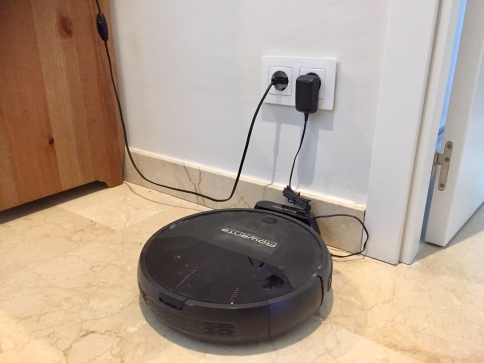
Manolo is not a family member or a pet… he is the robot vacuum cleaner my parents bought about a year ago in order to alleviate some tension in the home around cleaning.

Manolo is programmed to operate for about 2 hours a day and he goes about the house autonomously sweeping up dust and other debris. He does seem to have alleviated some tension and one big aspect of cleaning has been taken off of my parents’ plate.

Now Manolo and robot vacuum cleaners (“robovacs”), in general, are not enormous works of technology. They’ve been around for years (the first model came into the market in 1996), but have become much more intelligent and autonomous since then and have become a lot more present in homes due to dropping prices (though they are still relatively pricey with models ranging from about between 150 € for the most basic to around 500 € for the most high-tech ($170-$570)).

Models available now generally use sensors to avoid crashing into walls or falling down stairs and Manolo is generally pretty independent except when he gets stuck under furniture and someone has to come to get him. He’s pretty quiet and does his job adequately enough so that sweeping floors and manual vacuuming is no longer necessary at home, though obviously, he cannot get to all areas (stairs and under very low furniture, for example).
IMG_8707.jpg
Manolo in his charging station

It may seem like vacuum cleaners have nothing to do with gender and gender roles, but the disproportionate amount of time spent by women as compared to men on unpaid domestic labor are still staggering today, even in wealthy Western countries.

You may be surprised to find out that women on average spend about twice as many hours per day than men on household work which includes cleaning and caring for other people (generally children and older people), among other unpaid activities (cooking, errands, grocery shopping, etc.).

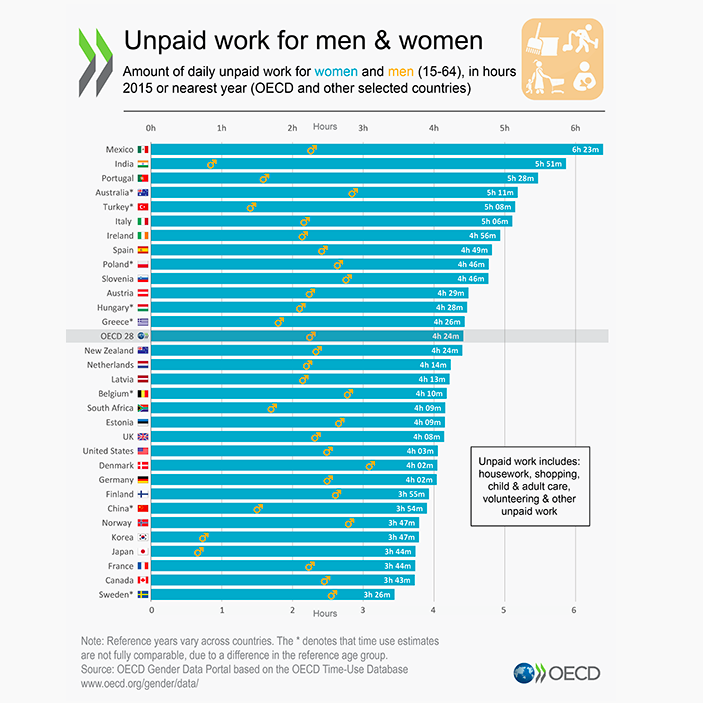
The OECD has a gender portal where statistics for all member states (since the making of this table, 8 more countries have joined the OECD) and other non-member countries such as China and India can be compared. Updated statistics can be found here.
captura de pantalla 2019-01-27 a las 12.04.31

According to the 2015 information, on average women in member countries spend 4 hours and 24 minutes per day on unpaid work, whereas men spend half that time (2 hours and 15 minutes). This not only has an impact on perceptions of gender roles whereby women are those that should bear the brunt of the housework, but it also means women have less time to work, study, spend leisure time (or even sleep!) and, thus, are more economically vulnerable. It also attests to the rise of the double burden felt by women which has been linked to increased anxiety and stress levels in women.

The OECD is an organization made up by generally wealthy nations. These are nations where women have already reached the workforce. Women work a full day on the labor market and come home to work another several hours at home. Though women have increased their paid work time, they have not achieved a corresponding reduction in their unpaid work hours. Nor have men increased their share of unpaid work at the same rate that women have increased their share of paid work. This data is further backed up by the 2015 Human Development Report published by the United Nations Development Program. 

According to this report:

“Of the 59 percent of work that is paid, mostly outside the home, men’s share is nearly twice that of women—38 percent versus 21 percent. The picture is reversed for unpaid work, mostly within the home and encompassing a range of care responsibilities: of the 41 percent of work that is unpaid, women perform three times more than men—31 percent versus 10 percent. Hence the imbalance—men dominate the world of paid work, women that of unpaid work. Unpaid work in the home is indispensable to the functioning of society and human well-being: yet when it falls primarily to women, it limits their choices and opportunities for other activities that could be more fulfilling to them.”

Autonomous technology, such as robotic vacuum cleaners, can alleviate those burdens placed on women by reducing the number of tasks needed to be carried out by humans and is, thus, a positive influence on general work-life balance. However, its impact is limited. It cannot address the sexist biases and perceptions that underpin this data and perpetuate these tendencies: there will always be housework and caregiving work to be done by humans and if these perceptions subsist, they will more-heavily fall on women.

The advent of robotic housecleaning devices (robot vacuum cleaners, self-cleaning litter boxes, air purifiers, robot mops, robot window cleaners) reminds me of when the washing machine became a household item. Before then, housewives hand-washed linens and clothes. In my village in the region of Burgos, Spain, women used to have to go to the public fountain and washing areas in order to fetch water and wash clothes.

Historical picture of women washing clothes in Poza de la Sal, Burgos. Source. 
Poza de la Sal, fuente, lavaderos y abrevaderos romanos
These public fountains and washing areas are no longer used but have been conserved. Source.

Washing machines, which became widely used in the US after WWII but took a little longer to come to Spain, turned an arduous task into something simple, quick and easy. Ads for washing machines around that time generally targeted women.

Washing machines and other home appliances that became prevalent during the second half of the 20th century in developed countries allowed women to start gradually detaching themselves from the home and pursue other more-fulfilling activities, but it did not change the fact that the burden of operating those machines still falls mostly on women and in many less-developed countries where these machines are still not accessible, women are still primarily charged with caregiving and housework.

Autonomous technology as applied to house-cleaning devices will allow many tasks to be completely forgotten by humans, but it will not change tendencies and perceptions regarding gender roles and housework for those tasks that still continue to exist, which means an educational and societal effort still has to take place by which gender roles are actively combated.

Technology is not the panacea, but it is a good starting point to get rid of menial tasks that no-one likes to do and it can also serve to raise some questions to get people thinking about the gender bias that still exists in our day-to-day life. This is the starting point for both men and women to question the reasons behind every-day activities and work towards better distribution of unpaid work.

You can start asking yourselves about what kind of patterns you experienced in your own home with your parents. Were housework and caregiving responsibilities equally spread between both parents? If you live with your own partner, how do you distribute these responsibilities? Is the distribution fair? What are the reasons behind hiring other people (which are generally still women) to clean your house or care for your children? What are the reasons behind investing in expensive technological devices? As a woman, do you feel pressure (internal and/or external) to take on more responsibilities around the house? If not, why? If yes, why? As a man, are you sensitive to these kinds of tendencies? Are you assertive about fair distribution of housework?

If you would like to share your own experience or thoughts about these issues leave a comment or write me an email!

Double standard toil and trouble!

So I wasn’t initially going to write about this topic but after such a strong wave of encouragement from all of you and the fact that several people wrote to me to bring to my attention a certain event that took place last week, I thought I might as well start out strong… and talk about vibrators.

Now, this isn’t your typical vibrator, it’s called the Osé Pleasure Wand, it was created by the Lora DiCarlo company with a team of experts from Oregon State University and it is a big deal in terms of micro robotic technology. It is set to launch in Fall 2019.

According to the Lora DiCarlo website, this gadget, set to launch in Fall 2019 at a retail price of around $250, is “the only product designed for hands-free blended orgasms. Using advanced micro-robotics it mimics all of the sensations of a human mouth, tongue, and fingers, for an experience that feels just like a real partner. No need for buzzing, desensitizing vibrations. It even flexes and adapts to your body for a personal fit that hits all the right spots – because there are better uses for your hands.”

Such a big deal, in fact, that it won an Innovation Award at the 2019 Consumer Electronics Show, an annual trade show organized by the Consumer Technology Association (CTA) held in January at Las Vegas, and then lost it… three weeks later.

This show is a big deal in the tech world and its been going on since the 1960s with pocket radios and TV’s with integrated circuits to now, where some of the highlights of this year’s show and other winners of the Innovation Award, female sex toy apart, was a Bluetooth Waterproof Speaker Bottle and a Harry Potter Coding Kit complete with a wireless wand. You can see all the winners here.

The Osé won a prize for showing “outstanding design and engineering” and then lost it, and thus their right to showcase their product at the show and attract big investment, because it was deemed by the CTA as “immoral, obscene, indecent, profane or not in keeping with CTA’s image”.

Now, not only is it crazy to be deeming a sex toy for women as indecent in 2019 in a show dedicated to consumer technology… it also highlighted a very serious double standard: the 2019 CES show showed moral reprobation of a high-tech “vibrator” but seemed not to mind about Solana, a robot sex doll for men created by Abyss Creations that was showcased this year.

Solana is a modular head that can be attached to a doll body and you can peel off her face and change it whenever potential consumers get bored. If you change her face with the peelable face of her sister doll Harmony, you can change her personality. Solana tells jokes, speaks with an accent and you can control her body functions, personality and speech from an app on your phone. How handy! Solana really is the living embodiment of female empowerment.

Imagine its face fell off while you were having sex with it.

You can see the whole video here.

However, this post is not about vibrators or sex dolls or what should be considered a good consumer product or even what should be allowed for exposition in a trade show. This post is about the really blatant double standards that still plague the electronics industry.

Is there something to be said about the fact that the administrators of the show considered the Osé to be indecent while allowing a fake robot woman that potential male consumers can control through their iPhones as it if were any other consumer product?

Not to mention the scantily clad female models or “booth babes” that a lot of the companies that present their products at CES hire in order to attract people to their booths (photo by Edward C. Baig from USA Today). For completeness, there is also a Virtual Reality porn booth.

So it’s not indecent to target investors (many of them men) by feeding into unrealistic and seemingly unhealthy sexual fantasies (be it with real women, robot women or virtual women) but it is indecent to promote female entrepreneurship and products related to female pleasure?

Lora Haddock, Lora DiCarlo’s Founder and CEO, wrote an open letter about the gender bias that still exists at CES which I advise you to read. She makes a valid point:

“This double standard makes it clear that women’s sexuality is not worthy of innovation. By excluding female-focused Sex Tech, CES and CTA are essentially saying that women’s sexuality and sexual health is not worthy of innovation. Dismissing an innovation in micro-robotics and biomimicry because the technology is in a pleasure product makes a strong statement. It seems the CTA is just fine with “female-oriented” products like breast pumps, Kegel exercisers, and even robotic vacuums – things that also benefit someone else – but something that squarely focuses on women’s sexuality is off the table.”

Not to mention that another winner of the 2019 Innovation Awards was a wearable band made by Owlet for expectant mothers to put around their belly while they sleep, allowing to track a baby’s wellbeing from inside the womb. Well, that’s great too but why can’t we have both?

Photo from the CES Innovation Awards site

This is not the first time that CES has shown gender bias nor will it probably be the last. But the outrage that this particular event has sparked shows that something is beginning to change. By normalizing female sex toys and rewarding the femtech behind, taboos regarding women and sexuality can be broken down and female-focused engineering encouraged.

CES is starting to feel the heat, I wonder if it will eventually learn from the burn…

For more information on the ridiculous gender bias displayed at the CES on this occasion and others please read this fantastic article by Valeriya Safronova in the New York Times. 

Tune in next week for more!

Femtech: why this blog exists

A couple of months ago, an idea started to stir in my head about how to join two of my most passionate centers of interest at the moment: women’s rights and status and emerging technologies.

Since there is no better time to start a project than taking advantage of the motivation of  a new year’s resolution, here is the start of a blog where I can talk about certain subjects that pique my interest regarding these two large topics, and, especially, how I see that new technologies both threaten and help the fight for greater equality between men and women.

I decided to name the blog The Fourth Wave because I find it fitting to a moment in history where two forces, seeminly unrelated, are starting to develop. On the one hand, the Fourth Wave of feminism, which started a couple years ago, represents a resurgence in concern for the empowerment of women in a society which still heavily holds sexist attitudes, though subtle and inadvertent. On the other hand, the advance of technologies such as artificial intelligence, robotics, machine learning, Internet of Things, etc., brings about a whole new set of challenges – and opportunities – for society to tackle some big social problems. This new wave of technology is also named by many as the Fourth Wave of the Industrial Revolution.

During my time researching and reading about both these topics, I found that they were – or could be – related… and that not enough attention was being paid to how the advances in technology could affect women (which is not surprising, as most of the people behind these advances are men)… which brings me to the title of the article.

When I came up with the term “Femtech” I proudly thought I had coined a new concept, only to discover through Wikipedia that the term “Femtech” already exists: Femtech (or Female technology) is a term applied to a category of software, diagnostics, products, and services that use technology often to focus on women’s healthThis sector includes fertility solutions, period-tracking apps, pregnancy and nursing care, women’s sexual wellness, and reproductive system health care.”

This here is Ida Tin, a Danish entrepreneur who coined the term “femtech” and co-founder and CEO of the menstruation and fertility-tracking app “Clue”. Though most of you (myself included) do not know about her, she was voted 2015 Female Web Entrepreneur of the Year at the Slush conference. 

-rpTEN - Tag 3 (26205678573).jpg

After overcoming the initial disappointment of not having coined the next big keyword in technology, I became even more disappointed about how a concept so seemingly large is reduced to an industry concerned about women’s health and reproductive system. It’s great that digital and standard tools aimed at women’s health are being designed by and for women but why are the opportunities of technology for women now only limited to our bodies whereas technology applied to other industries such as the finance industry have undergone amazing developments in only a couple of years.

My vision of femtech is an all-encompassing vision of how technology can serve women, help women achieve real social and economic equality and it is what I hope to see in the next several years. Though I don’t envision changing the world through my blog, I do wish to share and debate with readers about how women can better participate in and benefit from the vast changes that technology can bring about. Subjects that are interesting to me include how automation will specifically affect women, the sexual harassment and lack of diversity in the tech world, bringing attention to largely unknown female superstars in the tech world such as Ida Tin (sorry Jeff Bezos, Elon Musk and Mark Zuckerberg’s of the world), the gender dynamics of high-tech regulation (I am a lawyer nerd after all) and robots and the sex industry.

Hoping this little sneak-peak has left you wanting more… please come back and visit once a week for updates and leave comments, sugestions and feedback!